Chuzeday Blog

Practical Tips to Grow Your Service-Based Business

The power of rebooking: why protecting your clients futute appointments, protects your business
The Power of Rebooking: Why Protecting Your Client's Future Appoinmtnets Protects Your Business

Client Retention Through Advance Bookings: 20 Years behind the Chair Taught Me This

By Deborah Jordan, Founder, Chuzeday

When I ran my salons, I didn't set out with a grand rebooking strategy. But demand changed everything.

I was lucky—lucky enough to be so busy that if I didn't actively manage my clients' appointments, chaos would have followed. Women were waiting weeks for availability. My chair was in demand. And that's when I realised something crucial: managing rebooking wasn't just good for my business. It was good for them.

It became one of my core business values. And looking back, it's one of the best lessons I learned about what it actually means to run a successful service business.


The Problem Nobody Talks About: When Demand Meets Disorganisation

Here's what most service providers don't realise: your busiest clients are also your most frustrated ones.

When a client loves you—when they want to keep coming back because your work actually makes a difference to how they look and feel—they shouldn't have to fight you to get an appointment. Yet that's exactly what happens when rebooking isn't systematic.

Think about your best clients. The ones who say things like: "I want to come every six weeks" or "I need this every month." They're not being fussy. They're being smart about their own wellbeing. But if you don't manage that for them, here's what actually happens:

They call a week before they're due and get disappointed. "Can't fit you in until the following week."

They text because they're not sure of their slot. Back-and-forth messaging. Confusion.

They eventually go somewhere else because another salon made it easier.

And here's the painful part: you blame them for not rebooking. But actually, you left them with no choice.

When I realised this pattern in my salons, everything shifted. I understood that rebooking wasn't about being pushy. It was about being professional. It was about respecting their time as much as my own.


Rebooking Is Actually an Act of Care

Let me be completely honest: when a client sits in your chair and you talk about their next appointment before they leave, it feels like you're selling. Your brain might tell you it's transactional.

But it's not. It's the opposite.

When you synchronise your diary with your client's needs, you're saying: "You matter. Your time matters. Your results matter. And I'm going to make sure you don't fall through the cracks."

In my salons, something magical happened when women knew they were booked. Their shoulders relaxed. They didn't have to think about calling. They didn't have to hope there'd be availability. They knew when they'd be back in my chair, and they could move on with their lives.

That feeling—that sense of being looked after—is one of the strongest forms of loyalty you can build. It's not loyalty to a discount or a promotion. It's loyalty to a system that respects them.

Your clients don't want to manage their own bookings. They want to manage their lives. When you take the booking management off their plate, you become essential to them.


Why Rebooking Keeps Your Business Stable (And Your Sanity Intact)

Let's talk business for a moment, because this is real.

When you rebook clients while they're still in your chair, you do three things at once:

1. You fill your future calendar while you're working today.
Instead of scrambling to fill slots week-to-week, you're building momentum. Your calendar for next month, the month after, and beyond is already taking shape. That's stability. That's income you can plan around.

2. You reduce the chaos of last-minute scrambling.
No more messages at 9pm asking if you can fit them in tomorrow. No more panic when someone cancels. Your "crisis management" goes way down because you've already protected your time by filling it with people you want to work with.

3. You keep your best clients.
A rebooking machine like Chuzeday—one where clients know they're secured—turns one-time appointments into years of consistent business. This is the foundation of sustainable, predictable income. And in a one-person business, predictability is gold.


The Psychology That Actually Works: Synchronisation, Not Pressure

Here's something important: rebooking works best when it doesn't feel like selling.

When I'd say to a client: "You're usually every six weeks—let's get you in for the first week of April and then again mid-May so you're sorted," that was never pushy. It was practical. It was synchronisation.

I wasn't forcing anything. I was offering a solution to a problem she already had: "How do I make sure I can get in?"

Research backs this up. Clients who book ahead feel more in control. They're more satisfied. They're less likely to cancel. And they're more likely to refer because they know they can actually get an appointment.

When you frame rebooking this way—as protection, not pressure—clients want to participate. They're choosing stability. They're choosing to look after themselves.


It's Not About Pushing; It's About Professional Standards

Let me be really clear about something: rebooking is part of your professional standard as a service provider.

When a doctor's receptionist says, "Let's book your next check-up now," that's not pushy. That's professional care.

When a hairstylist or beauty says, "You usually come every five weeks—let's get your next few in the diary," that's not selling. That's doing the job properly.

Somewhere along the way, solopreneurs internalised a belief that asking for rebooking is uncomfortable or aggressive. It's not. It's the opposite. It shows respect. It shows you have a system. It shows you take your work seriously.

Your best clients—the ones who actually care about their results—will respect you more for having a rebooking structure. They'll feel looked after. They'll tell their friends: "She gets me in and keeps track of everything."


What Changes When Rebooking Becomes Non-Negotiable

In my salons, once I made rebooking a core value—not optional, but part of how I did business—three things happened:

My income stabilised.
I could look at next quarter and know roughly how many clients I'd serve. That's the kind of visibility solopreneurs desperately need.

My stress dropped.
No more wondering if next week would be busy or slow. No more anxiety about making ends meet. The machine was running.

My clients felt genuinely cared for.
Women would come in and say, "It's so nice knowing I'm booked in." They felt the care in the system. They felt like I was managing their wellbeing, not just their appointments.

That's when I understood: rebooking is a business model. It's a mindset. It's how you communicate that you're professional, organised, and serious about looking after people.


The One Thing Holding Most Solopreneurs Back

I talk to dozens of service providers—hairdressers, coaches, therapists, trainers—and the conversation often goes like this:

"Deborah, I love what I do. I'm fully booked right now. But I'm stressed all the time, and I don't know where my next client is coming from."

Here's what's usually happening: they're not rebooking systematically. They're relying on a mix of repeat clients, walk-ins, and referrals. One person cancels and suddenly there's a hole. One week is quiet and they panic.

But once you implement rebooking—once you make it part of your checkout conversation and track it properly—everything shifts. Suddenly you can see six months ahead. Suddenly you know your client pipeline. Suddenly you're not running on hope; you're running on data.


How to Start: The Simple Framework

If you're ready to make rebooking a core value (like I did), here's what I'd suggest:

At every appointment, before checkout:
"You're usually with me every [timeframe]—let's book your next couple of appointments now so you're sorted. Are you an early-morning person or do you prefer late afternoons?"

Make it easy:
Hand them your phone (or tablet) and let them book directly into Chuzeday while they're sitting there. No friction. No delay. They see the calendar, pick their slots, and it's confirmed instantly. They might even add it to their own phone right then.

Offer flexibility:
"If anything changes, you can reschedule anytime through the app. But for now, let's protect your time."

Track it:
How many clients rebook at checkout? You need that metric. It tells you everything about the health of your business.

For clients who don't rebook in the chair:
Chuzeday sends them a friendly reminder when they're due. Not pushy. Just helpful: "You're usually due around [date]—I've got a few slots open if you'd like to book in."


The Technology Should Support It, Not Replace It

Here's the thing about tools like Chuzeday: they're not meant to do the work for you. They're meant to make your rebooking work easier.

The real rebooking happens in the chair. It happens in that conversation. It happens when you say, "I want to look after you, and that means we get you booked in."

But here's what's changed the game for me: with Chuzeday's guest app, your client can book their next appointment right there while they're sitting in your seat. No awkward back-and-forth. No "I'll text you the dates." No follow-up emails. They just tap, pick their slot, and it's done. Locked in. Both of you know it's real.

Once you've had that conversation and they've booked on the app, technology handles the rest:

  • Automated reminders so they remember their booking.
  • Online rescheduling if their life changes.
  • A simple system so you can see what's actually booked versus what's hoped for.

Technology amplifies your professionalism. It doesn't replace it. The human part—the care, the conversation, the synchronisation—that's on you. But now the system is the backbone that helps you scale it without chasing people.


The Real Reason Your Best Clients Stay

At the end of the day, rebooking isn't about tactics. It's about demonstrating that you see them as valuable enough to protect their future access to you.

When a client knows she can count on getting in, when she doesn't have to panic about availability, when she feels managed in the best sense of that word—that's when she becomes loyal. Not to a discount. Not to a brand. But to you as a professional who respects her time.

That's what built my salons. That's what keeps solopreneurs sustainable. And that's the core value that should be at the heart of every service business.

Your clients don't need you to be perfect. They need you to be organised. They need you to care enough to think ahead for them.

Rebooking is how you prove that.


Ready to make rebooking work for you? Start with one conversation this week. One client. One simple question: "Let's get you booked in for your next appointment." See how it feels. Then build from there.

That's how I did it. And it changed everything.

Read More →
Profile picture of Founder Deborah Jordan
Starting Your Own Solo Business? My Top 12 important tips to help you start a New Business on Your Own

Hi, I’m Deborah.
Welcome to my Business Blog.
I’m delighted to share my tacit knowledge of running an Individual Business with you.
Please enjoy this topic – it’s one of my favourites.

My top 12 tips on “How To” Start Up Your Own Self-Employed/ Solopreneur Business

A space for people who are ready to step out of employment and into independence.

Twenty years ago, I stood exactly where you might be now: excited, overwhelmed, a little scared – but absolutely sure that working for myself was the right move.

I was good at what I did. It was time to be independent.
Two decades later, I can say this: it has been one of the most rewarding decisions of my life.

If you’re thinking about becoming self-employed or starting a small business in 2026, this edition is for you. I want to fast‑forward you with the knowledge I’ve picked up over that period of time – and be very honest: I’m still learning every day.


My Top 12 Tips to Start Your Small Business (Ireland)

1. Choose a business name
Make it:

  • Easy to say and spell
  • Memorable and professional
  • Aligned with what you actually do

Check that it’s available on:

  • CRO
  • Domain names
  • Social media handles

2. Apply to the C.R.O (Company Registration Office)
This makes your business official and visible. Decide if you’re registering as a sole trader or company, and complete the paperwork early. It sets a professional foundation.


3. Register with Revenue
Once you’re registered with the CRO, register with Revenue for tax.
This keeps you compliant and avoids future headaches.


4. Open two business bank accounts
This is one of my strongest recommendations:

  • 1 account for business income & expenses
  • 1 account for VAT (if applicable)

Keep business and personal completely separate.
It reduces stress, protects you at tax time, and helps you actually see how your business is performing.


5. Set up your space and tools
If you’re taking appointments or seeing clients:

  • Decide where you’re working (home, salon, studio, office, shared space)
  • List the furniture and equipment you need
  • Get a separate business mobile number – this creates boundaries and looks professional

6. Create a professional email address
Aim for something like:
yourname@yourbusinessname.com

This small detail makes a big difference in how seriously people take you.


7. Health and Safety – it’s a legal requirement
If you have a physical space or see clients in person, you must understand Health & Safety obligations. Check the relevant Irish guidance for your industry and put simple, clear systems in place.


8. Get insurance in place
Depending on your business, you may need:

  • Public liability
  • Professional indemnity
  • Premises / contents cover
  • Treatment risk (for beauty, wellness etc.)

One incident without insurance can wipe out a small business. Don’t skip this.


9. Know your overheads
List out your fixed and regular costs:

  • Rent / space
  • Utilities
  • Insurance
  • Software and tools
  • Marketing
  • Accountant / professional support

Knowing your monthly overheads tells you exactly what you need to bring in before you pay yourself. That’s crucial for pricing.


10. Decide: sole trader or company?
This has legal and tax implications.

  • Sole trader: simpler to set up, but you and the business are the same legal entity
  • Limited company: more structure and admin, but separate legal entity and potential advantages

Check Citizens Information for clear comparisons, and speak to an accountant before deciding.


11. Use a digital tool to manage bookings & payments
Trying to run everything with a notebook and your personal WhatsApp will burn you out quickly.

Use a digital tool (for example, Chuzeday) to handle:

  • Bookings
  • Payments
  • Scheduling
  • Client management
  • Day‑to‑day admin

Automating this side of the business gives you back time and mental space to serve your clients and grow.


12. Plan your future – pensions & investments
When you’re self-employed, no employer is setting up a pension for you.

Talk to:

  • A financial advisor
  • Your accountant
  • Experienced local business owners

Start small if you need to, but start. Your future self will thank you.


Helpful Irish Resources

  • CRO: cro.ie
  • Revenue: revenue.ie
  • Citizens Information: citizensinformation.ie
  • Health & Safety Authority: hsa.ie

Don’t leave it for another year!!

Starting a business is exciting, overwhelming and deeply rewarding.
If you know you’re good at what you do and you’re ready to take that step towards independence, the best time to start is now.

If you’d like help setting up a space to take appointments or simplifying the admin side of your solo business, that’s exactly what my business Chuzeday specialises in –

Welcome to a new journey in 2026 …You’ve got this.
👉 Hit the website to find out more about setting up your instant business on Chuzeday. www.chuzeday.com  for payments bookings and deposits and so much more.
Read More →
Young man smiling with confidence that his revenue payments are on time because of Chuzeday.
Keeping the Revenue Panic at Bay: Why Clear Income Records Make Self-Employment Less Stressful

There is a moment familiar to almost every solo business owner in Ireland. You are going about your day, juggling appointments and messages, when a brown envelope arrives with the kind of authority only government stationery can achieve. Even before you open it, your stomach drops. The worry is rarely about doing something wrong. It is about not being entirely sure what you earned, what you submitted, or whether something slipped through the cracks during a busy season.

This is the part of self-employment nobody puts on Instagram. You can love your work, love your clients, and be brilliant at what you do, yet still feel a quiet dread when tax time rolls around. The modern reporting system does not make that feeling any easier. Banks share information automatically. Payment platforms file annual summaries and report earnings. Revenue’s systems have become more connected, not because anyone is targeting the self-employed, but because transparency has become standard across the financial world.

For someone working alone, this shift creates a practical challenge. If your own records are scattered, incomplete, or buried under the mental clutter of running a business on your own, the numbers held by Revenue may look more accurate than the ones you were hoping to rely on. That is where the anxiety begins. Not in wrongdoing, but in uncertainty.

The Hidden Cost of Disorganised Income

Most solo providers are not sitting on piles of unrecorded earnings. They are sitting on piles of unrecorded admin. When you work alone, the priorities are obvious. You focus on the client in front of you. You follow up with the person who has been waiting. You squeeze in the appointment that ran over. Every day is a small balancing act.

The problem is that income doesn’t arrive in a single tidy stream. A morning client books with an online deposit and settles in cash.. The afternoon client pays with cashless. Someone slips cash into your hand on the way out. A new customer messages you on WhatsApp. The numbers scatter before you even realise it. Months later, when your accountant asks for records or Revenue sends a reminder, you are left stitching together a financial quilt that never quite aligns.

This is why so many self-employed people dread preliminary tax. If your income varies throughout the year, estimating what you owe for the current year while filing for the previous year becomes a form of educated guesswork. Some people overpay to be safe. Others underpay and hope for the best. Neither feels particularly reassuring.

Why Income Visibility Matters More Than Ever

The real shift business owners are feeling today has nothing to do with new penalties or harsher rules. It is the gap between what financial institutions now report automatically and what business owners have the capacity to track manually. Revenue is not asking small businesses to become accountants. They are simply matching information that already exists. If the numbers do not match, the system assumes something is missing.

The good news is that most of this anxiety fades when your own records match the real activity in your business. Consistent, simple income tracking does more than keep you organised. It gives you confidence. It lets you breathe. It removes the sense that you are always one step behind.

This is also why tools like Chuzeday were created. Not as a replacement for accountants or tax software, but as a safety net for the part of the process that most people struggle with: keeping track of what you earned on any given day, across every type of payment, without needing a spreadsheet or a spare hour you don’t have.

The Role Chuzeday Plays in All of This

Chuzeday does not try to handle the technical side of tax season. That territory is better left to the people who enjoy spreadsheets in a way most of us never will. What Chuzeday does very well is help you build clean, usable records without thinking about it. Every booking sits beside the payment that followed. Every transaction is logged in one place. The information you need for tax season is created naturally as you work.

For many people, this is the difference between hoping their records make sense and knowing they do. You can open your dashboard and see what your year has looked like, not in abstract terms, but in actual appointments, payments and  discounts where you gave them. If something is missing, you notice it when it is still easy to fix. If your accountant asks for evidence of income, you have it without needing to dig.

This clarity also makes preliminary tax less dramatic. When you can see your income trend throughout the year, your estimate becomes more realistic. You stop guessing. You start planning. You know when a quiet month will matter and when a busy season has changed the shape of your year.

The Practical Benefits Nobody Talks About

There is a deeper emotional benefit to this kind of clarity. Self-employment already requires steady nerves. You make your own decisions, set your own hours, and carry the full weight of your work. The background anxiety around finances does not need to add to that. When your income is easy to understand, the rest of your business becomes easier too.

You can price your work more confidently because you actually know what you are earning. You can decide whether you can take a week off without working overtime to make up for it. You can see which services are carrying your revenue and which ones are creating more work than worth.

This is the kind of practical insight that helps a solo business owner grow sustainably, not recklessly. It is the kind of insight that protects you because you want to run a real, grounded, legitimate business that reflects the effort you put into it.

A Better Way Forward for Solo Providers

None of this requires a degree in finance. It does not require mastering accounting software or building a dashboard with graphs you do not understand. It requires one thing: a place where the pieces of your business come together in a way you can trust. For many people, that place is Chuzeday, not because it covers every financial base, but because it supports the part of the process that tends to fall apart first.

When your income is recorded clearly, everything else becomes easier. Your accountant breathes a sigh of relief. Your tax season becomes predictable. Your decisions become informed. And you get to focus on the work you actually enjoy.

Self-employment will always involve a few unknowns. Your income does not have to be one of them. Chuzeday helps you replace guesswork with clarity, and clarity with confidence, so the next time a brown envelope arrives, it feels like another piece of admin rather than a warning sign.


Read More →
Business man at his work desk with his hands on his head, symbolising the difficulty of working for yourself and how using some software can have you riddled with frustration.
Why Most Business Tools Make Solo Providers Feel Worse, Not Better


For all the noise about productivity, running a solo business has never felt busier. Every tool promises to help you “work smarter, not harder.” Yet for many self-employed people, the result is a cluttered desktop and a creeping sense that the tools are working them, not the other way around. Somewhere between the subscription sign-up and the seventh password reset, the dream of digital efficiency starts to look suspiciously like more admin.

The irony is that most software is designed for teams, not for individuals whose business runs through their own two hands. You can see it in the setup screens that ask for “team roles,” the dashboards that assume multiple users, and the endless integrations built for people who already have a project manager to connect them all. When you’re the marketer, the accountant, the customer service rep, and the cleaner, these systems can feel less like support and more like a list of chores.

Efficiency, after all, is relative. For a solo provider (a designer, consultant, yoga instructor, or gardener), efficiency often looks like fewer steps between doing the work and getting paid. It’s knowing that the person who booked an appointment will actually show up, that invoices don’t vanish into inboxes, and that messages are in one place instead of scattered across platforms. But most tools chase scale, not simplicity. They assume that “growth” means more users, more automation, more features. For someone working alone, more is rarely the goal.

Part of the problem is cultural. The software industry rewards innovation that looks complex. Simplicity is often mistaken for lack of sophistication, even though it’s much harder to achieve. Many tools are built for investors, not users. They have to look like they can expand into enterprise-level solutions. So even when a product starts small, its roadmap quickly veers toward the needs of teams with budgets, hierarchies, and IT departments. The solo operator, who just wants to stop double-booking clients, gets left behind.

There’s also the psychological weight of “tool guilt.” Every small business owner knows the feeling: the monthly reminder that another subscription has renewed for something you haven’t opened in weeks. You tell yourself you’ll use it properly next month, that it’s an investment in efficiency. But beneath that good intention is fatigue. When you spend more time learning systems than using them, the tools stop serving you and start judging you.

It’s not that software is bad. Digital tools have given solo businesses reach and flexibility that would have been unthinkable twenty years ago. The issue is fit. A carpenter wouldn’t use a sledgehammer to hang a picture frame, yet many solo providers end up using enterprise-grade platforms to manage simple daily tasks. A client booking doesn’t need a full customer relationship management system. A payment link shouldn’t require a tutorial. When every small task needs its own login, context-switching becomes a hidden cost… one that erodes focus and energy.

What’s worse, most tools measure success by activity, not impact. They encourage tracking, scheduling, reporting, and optimising, until the act of doing the work is buried under the task of managing it. The average solo provider spends hours each week on unpaid digital maintenance, which includes updating availability, chasing payments, syncing calendars, and cleaning inboxes. These hours don’t appear in financial statements, but they show up in burnout statistics. It’s the tax of modern self-employment.

The most useful technology for small operators isn’t necessarily the most advanced; it’s the one that understands the rhythm of how they work. Real life doesn’t happen in neat workflows. A client cancels at the last minute. The Wi-Fi drops during an online session. The dog barks during a call. Tools that assume perfect consistency are destined to frustrate. The best systems flex with the chaos, quietly handling the repetitive parts so humans can handle the unpredictable ones.

That principle is what shaped Chuzeday. It wasn’t designed in a boardroom full of growth projections; it was built by people who’ve lived through the messy reality of solo work. The goal wasn’t to add more features, but to remove friction. One login that brings bookings, messages, and payments together. One system that feels calm rather than clever. A place where “getting organised” doesn’t mean learning a new language of settings and integrations.

In that sense, Chuzeday isn’t trying to reinvent how solo providers run their businesses. It’s trying to make the invisible work visible, then gently reduce it. The reminders that used to take an hour on Sunday night? Automated. The client who needs to reschedule? Done with one click. The invoice that always gets forgotten? Sent without fanfare. It’s a thoughtful design built for how people actually operate when no one else is there to pick up the slack.

What solo providers need isn’t more software, it’s more breathing room. The kind of space that lets them focus on the part of the job they’re good at… the craft, the service, the human connection. That’s what most “productivity” tools miss: they chase metrics while users chase calm. The future of small business technology doesn’t lie in endless new features. It lies in creating systems that feel like support instead of another demand on your attention.

Because at the end of a long week, what matters isn’t how many tabs you kept open. It’s whether you had the mental energy left to enjoy the work you chose to do in the first place.


Read More →
Solo provider writing in a colourful planner with blocked time, symbolising business boundaries for solo providers and the importance of protecting time.
The Business Case for Boundaries

Why Solo Work Blurs the Lines

For many solo providers, the workday has no clear edges. A lunch break gets swallowed by client calls, evenings become a time for invoicing, and weekends serve as a space to catch up on the things that never quite got done during the week. The division between work and personal time fades because responsibility rests entirely on one set of shoulders. When you are the booker, the biller, and the service provider all at once, boundaries do not erode suddenly. They slip away piece by piece until availability feels endless.

This pattern is reinforced by the expectations around independence. Clients often assume that direct access to a provider means constant access, with messages answered quickly and rescheduling handled at a moment’s notice. Family and friends may assume the flexibility of self-employment extends to every aspect of life. What looks like an open calendar on the outside often feels like a crowded one on the inside, full of obligations that have nowhere else to go.

The Costs of Constant Availability

The absence of boundaries carries a toll, because burnout starts to creep in as energy is spread too thin across too many hours, and concentration starts to falter when there is no pause to recover. A single late-night email, answered while tired, can lead to mistakes that require a morning to fix.

There is also the build-up of resentment. Many providers begin with a deep commitment to their clients, only to find themselves frustrated when that commitment is repaid with ever-rising demands. This resentment does not announce itself dramatically; it seeps into the tone of responses, into the reluctance to take on new work, and into the slow erosion of enthusiasm. Over time, the promise of independence starts to feel like a trap.

The irony is that availability, which was meant to show dedication, begins to undermine trust. Clients value energy, clarity, and reliability more than immediate replies, and a provider stretched too thin cannot offer any of those consistently. Presence without capacity is not a gift; it’s a liability.

Tools for Protecting Time

Boundaries last longer when they are anchored in small, repeatable habits. One of the simplest is calendar blocking. Treating lunch, a focused work session, or a school run as an appointment gives it the same weight as a client booking. When the calendar shows that slot as unavailable, it becomes harder to push aside. Over time, this habit changes how both provider and client see that time: no longer optional, but protected.

Technology can strengthen these choices if used with care. Automated availability means clients only see the times you are truly free, reducing the chance of awkward overlaps. Confirmation emails and reminders reassure clients without pulling you into constant messaging, and even a clear cancellation policy built into the booking process protects both your income and your energy. These systems create structure in the background, removing the need for constant vigilance.

Communication ties it all together because boundaries are respected when they are visible. A short line in a booking confirmation that explains when you respond to messages, or a note about office hours on your website, signals consistency. Clients rarely resent clarity. If anything, they find it easier to trust a provider who shows how the relationship will work from the beginning.

Boundaries as Sustainable Strategy

When boundaries are in place, they do more than protect individual days. They shape how the business functions over time. A schedule that includes breaks, time off, and clear working hours creates conditions for consistency. The quality of work holds steady, relationships with clients remain respectful, and decisions are made with a clearer head.

These practices also build a certain kind of trust because clients learn what to expect and are less likely to test the edges when those edges are visible. Predictable service creates loyalty in a way that constant availability never can. Independence, after all, was meant to allow control over your work rather than to let work control you.

Boundaries, then, are not a defensive wall but part of the foundation. They support the business by making it durable: less prone to exhaustion, more able to deliver what was promised, and strong enough to grow without collapsing under the weight of endless demands.

Keeping the Balance

For solo providers, independence was never about working all the time. It was about shaping work in a way that feels sustainable. Boundaries make that possible. They preserve the energy needed for service, protect the attention needed for detail, and support the relationships that turn first-time clients into long-term ones.

The business case here is clear: when time is protected, work is better, trust grows, and independence remains worth having. Boundaries are not an obstacle to growth. They are the framework that allows growth to stand.

With Chuzeday, you work smart, not hard. And that’s what modern solo business is all about.

Ready to Organize, Automate, and Thrive?

LEARN MORE WITH OUR BONUS MATERIALS Click Here Now

Ready to Feel Empowered?

I highly recommend you take the next steps to learn more and understand the power of what Chuzeday can do for you!

We know that trying new software can feel overwhelming, but getting started with us is quick and hassle-free. Plus, our team is here to support you every step of the way!

Click here to start your Journey on Chuzeday "GO", No Commitment No Subscription Fee

Here’s to your success!

Deborah
 

Read More →
Desk cluttered with papers, sticky notes, and printouts pinned on a wall, symbolising how small unfinished tasks can overwhelm mental space.
When Small Tasks Take Up Too Much Space

The Problem of Open Loops

On the surface, an unfinished task is nothing more than a line item. Send an invoice. Confirm a booking. Reply to a client. Each looks trivial on its own, the kind of job you might tell yourself you’ll “just remember” until you get a chance to do it. Yet anyone who has ever run a small business knows these tasks rarely sit quietly. They rattle around in your head, resurfacing when you are cooking dinner, trying to sleep, or finally settling down to work on something more important.

Psychologists have a name for this phenomenon: the Zeigarnik effect. First observed in the 1920s by researcher Bluma Zeigarnik, it describes how unfinished tasks are more likely to intrude on our thoughts than those we’ve completed. In her study, she noticed that waiters in a café could recall unpaid orders with remarkable accuracy but quickly forgot the details once the bill was settled. Our brains, it seems, are wired to keep incomplete tasks alive, constantly reminding us that something is left undone.

The Solo Provider’s Burden

For solo providers, this wiring creates a well-known kind of burden. When you are the one managing every booking, payment, and follow-up, your mental space becomes crowded with what are essentially “open loops.” Each loop demands attention, even if you cannot act on it immediately. The result is a low-level cognitive hum, the background noise of responsibility that never quite switches off. This is why you may feel exhausted at the end of a day that looks unremarkable on paper. The fatigue is not just from the work you did, but from the work you were holding in your head.

How Loops Drain Focus

The impact goes beyond personal stress. Open loops affect decision-making and focus. Studies have shown that the Zeigarnik effect can improve memory for unfinished tasks, but at the cost of concentration on other work. That might explain why you find yourself rereading the same email three times or struggling to start a larger project: part of your mind is still occupied with that unpaid invoice or unanswered message. In the economics of attention, half-finished admin collects a steep interest rate.

Simple Ways to Close the Loops

There are, however, practical ways to lessen the load. The first is deceptively simple: write things down. A to-do list, notebook, or digital task manager does more than provide organisation. It offers your brain permission to let go. Once the task is captured somewhere reliable, the mental loop can close. Researchers have found that creating a plan for unfinished tasks reduces their intrusive effect, even if the plan is as basic as “I’ll do this tomorrow at 10 am.” It is not the completion itself that brings relief, but the assurance that completion has been scheduled.

Another approach is batching. Rather than handling every small request as it arrives, group similar jobs and do them in a single block. Many solo providers already apply this logic without naming it, setting aside a morning each week for invoicing or an afternoon for client emails. The benefit is not just efficiency but peace of mind. Instead of carrying the thought all week, “I need to send that invoice”, you can remind yourself, “I have an invoicing block on Thursday.” The task still exists, but the loop closes because its future is accounted for.

Systems, Not Just Tools

Technology can help, though only if used with restraint. Reminders and scheduling tools provide the external memory that humans are not designed to maintain. Yet there is a caution here. Adding too many systems can create the same mental clutter you were trying to escape, only now dressed in notifications and pings. The point is not to digitise your stress but to shift responsibility away from your head and into a process you trust.


Consider the experience of a freelance yoga instructor who once described her evenings as “a running commentary of things I hadn’t done.” Messages from clients asking to reschedule would sit in her mind for hours until she found time to reply. Payments would linger on scraps of paper until she was at her laptop. She eventually began using a simple rule: every task must be either done immediately, written down, or scheduled. Within weeks, she found she was sleeping better, not because her workload had changed, but because the constant loop had stopped.

A Culture of Carrying Too Much

This is where systems matter more than tools. You do not need a specialised app or expensive software to escape the Zeigarnik effect. A notebook can work if you trust it. A calendar can work if you use it consistently. The essential shift is from memory to method, from “I’ll keep it in my head” to “I have a place for this.”

There is also a cultural element worth noting. Solo providers often pride themselves on keeping everything under control, seeing memory as a badge of competence. Forgetting to follow up with a client feels unprofessional, so the instinct is to grip tighter, to hold more in the brain as proof of diligence. Yet the irony is that this vigilance is what erodes reliability. The more you try to carry, the greater the chance something will slip through. Systems are not a sign of weakness; they are the scaffolding that allows expertise to stand tall without toppling under its own weight.

From Evolution to Everyday Work

The lesson from Zeigarnik’s observation is not that humans are flawed for remembering unfinished work. It is that we are human. Our minds evolved to keep loose ends in view because, historically, forgetting them might have meant danger. In the modern economy, the danger is less likely to be a predator in the grass than a client chasing an overdue invoice, but the brain has not updated its settings. If you want relief, you need to build the external structures that evolution forgot to install.

Solo business owners are particularly exposed to this pressure because they work without the buffers of a team. A larger company can delegate, outsource, or distribute tasks across roles. A sole provider has only one option: create systems that serve as an external brain. Whether that means a handwritten checklist, a recurring reminder, or a simple app is less important than the principle. What matters is that tasks are given a place outside your head, so your head can be used for the work that actually requires it.

In the end, the question is not how to become more efficient or more productive. It is how to become less preoccupied. When you release your brain from carrying open loops, you gain back the energy to think, to create, and to rest. That is not a luxury. It is the condition for doing meaningful work without burning out under the invisible weight of what remains undone.

With Chuzeday, you work smart, not hard. And that’s what modern solo business is all about.

Ready to Organize, Automate, and Thrive?

LEARN MORE WITH OUR BONUS MATERIALS Click Here Now

Ready to Feel Empowered?

I highly recommend you take the next steps to learn more and understand the power of what Chuzeday can do for you!

We know that trying new software can feel overwhelming, but getting started with us is quick and hassle-free. Plus, our team is here to support you every step of the way!

Click here to start your Journey on Chuzeday "GO", No Commitment No Subscription Fee

Here’s to your success!

Deborah

Read More →
Chuzeday Logo

For Business

Start managing your business with Chuzeday today.

Download App

Google PlayApp Store

Why Chuzeday for Your Small Business?

Chuzeday is the Ultimate Business Tool-Box for the Solo Service Business Owner. An Easy, All-In-One Digital Solution to Simplify Your Bookings, Payments and Admin. You are in Full Control—Live in Under 60mins without Subscription.

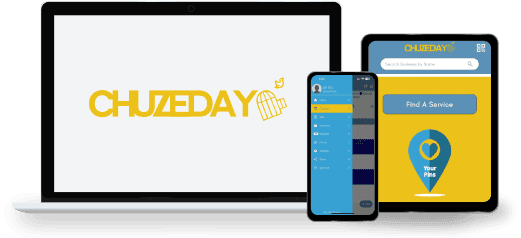
Chuzeday platform overview highlighting tools for solo business owners